


From drafting the PPM (Private Placement Memorandum) to operational agreements, you’ve finally made it to the AIF (Alternative Investment Fund) documentation pathway. Congratulations!
Knowing the “what” and “why” is half the battle; the real challenge is execution – doing things in the right order, with the right documents, by the right deadlines.
This post is your master checklist that consolidates the key actions from this series and SEBI’s rules for launching and running a compliant AIF in India.
How to Use This Checklist
Work through the phases sequentially.
Copy this into your project management tool.
Assign owners, due dates and artifacts for each action.
Phase 1: Pre-Application
Objective: Have your structure, rulebook and team ready before you approach SEBI.
1) Finalize Fund Structure
Choose legal form: Trust / LLP (Limited Liability Partnership) / Company
Deliverables: Draft Trust Deed / LLP Agreement / MOA (Memorandum of Association) & AOA (Articles of Association)
2) Draft the PPM (Your Rulebook)
Use SEBI’s prescribed PPM template: Annexure 1 (Category I/II), Annexure 2 (Category III)
Include all minimum disclosures; add a tabular fee example & distribution waterfall
Compile 5-year disciplinary history (AIF, sponsor, manager, directors/partners and trustee)
3) Initial Compliance Readiness
Confirm sponsor/manager fit & proper
Verify key investment team experience/qualifications
4) Appoint Key Advisor
Engage a SEBI-registered Merchant Banker (not an associate) to file the PPM and issue the due-diligence certificate
Phase 2: Application to SEBI
Objective: Submit a complete and compliant registration package.
Form A: Complete the primary application form
Attach: Executed structure documents, Draft PPM, Merchant Banker Due-Diligence Certificate (Annexure 3) and fee proof
File online: Submit via the SEBI Intermediary Portal (SI Portal)
Phase 3: Post-Approval
Objective: Stand up the operating basics after you receive the registration certificate.
Open bank accounts: Scheme-wise, segregated accounts only in the AIF’s name
Apply for PAN (Permanent Account Number) for the AIF entity
File the final PPM (incorporate SEBI comments) through the Merchant Banker
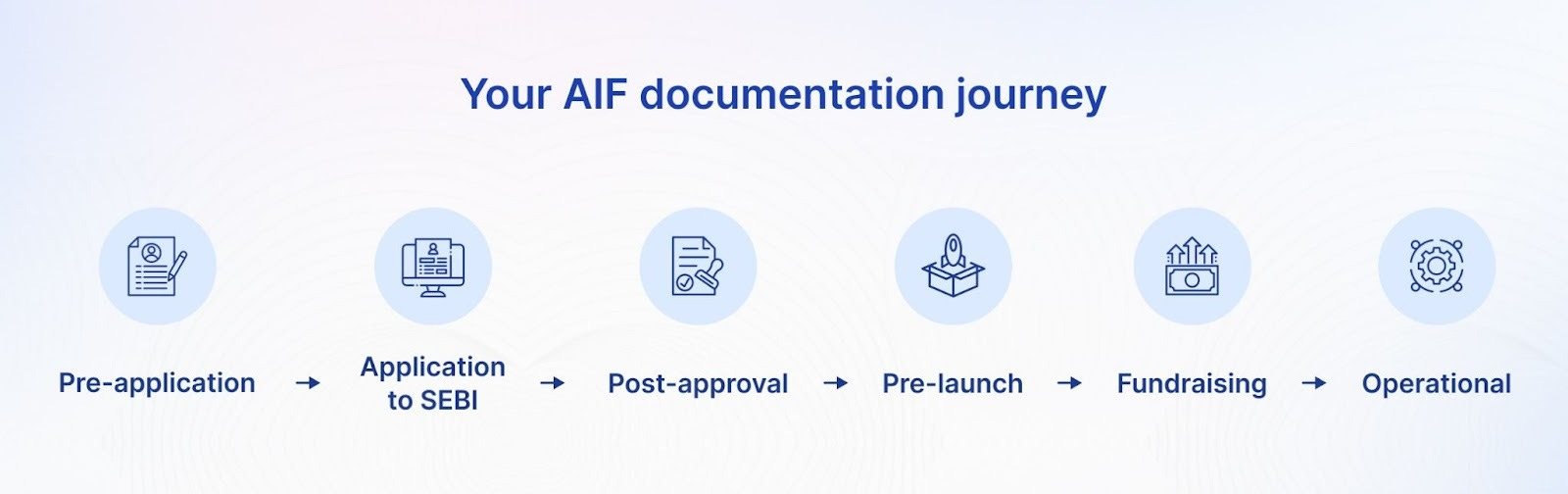
Phase 4: Pre-Launch
Objective: Put guardrails in place before you invest.
Appoint a Custodian: Execute the agreement before the first investment
Transition relief: Existing Category I/II schemes with corpus ≤ ₹500 Cr (and at least one investment as of Jan 12, 2024) must appoint by Jan 31, 2025
Investment Management Agreement (IMA): AIF ↔ Manager; ensure full consistency with the PPM
Declare “First Close”:
Deadline: within 12 months of SEBI’s communication taking the PPM on record
Corpus: meet minimums (e.g., ₹20 Cr for most AIFs; ₹100 Cr for SSFs (Special Situations Funds))
Sponsor/Manager commitment: cannot be reduced post first close
Phase 5: Fundraising
Objective: Legally onboard investors and secure commitments.
Subscription Agreements for each investor (must not go beyond/contradict the PPM)
KYC (Know Your Customer) / AML (Anti-Money Laundering) for all investors; eligibility checks (FATF/IOSCO/MoU where applicable)
Side Letters (if any): Only if consistent with the PPM and not prejudicial to other investors
Capital Calls: Issue notices when funds are required for investments and fees
Phase 6: Operational
Objective: Maintain compliance with scheduled reporting and documentation.
A) Annual PPM Audit
Audit compliance with PPM terms (internal or external auditor/legal professional)
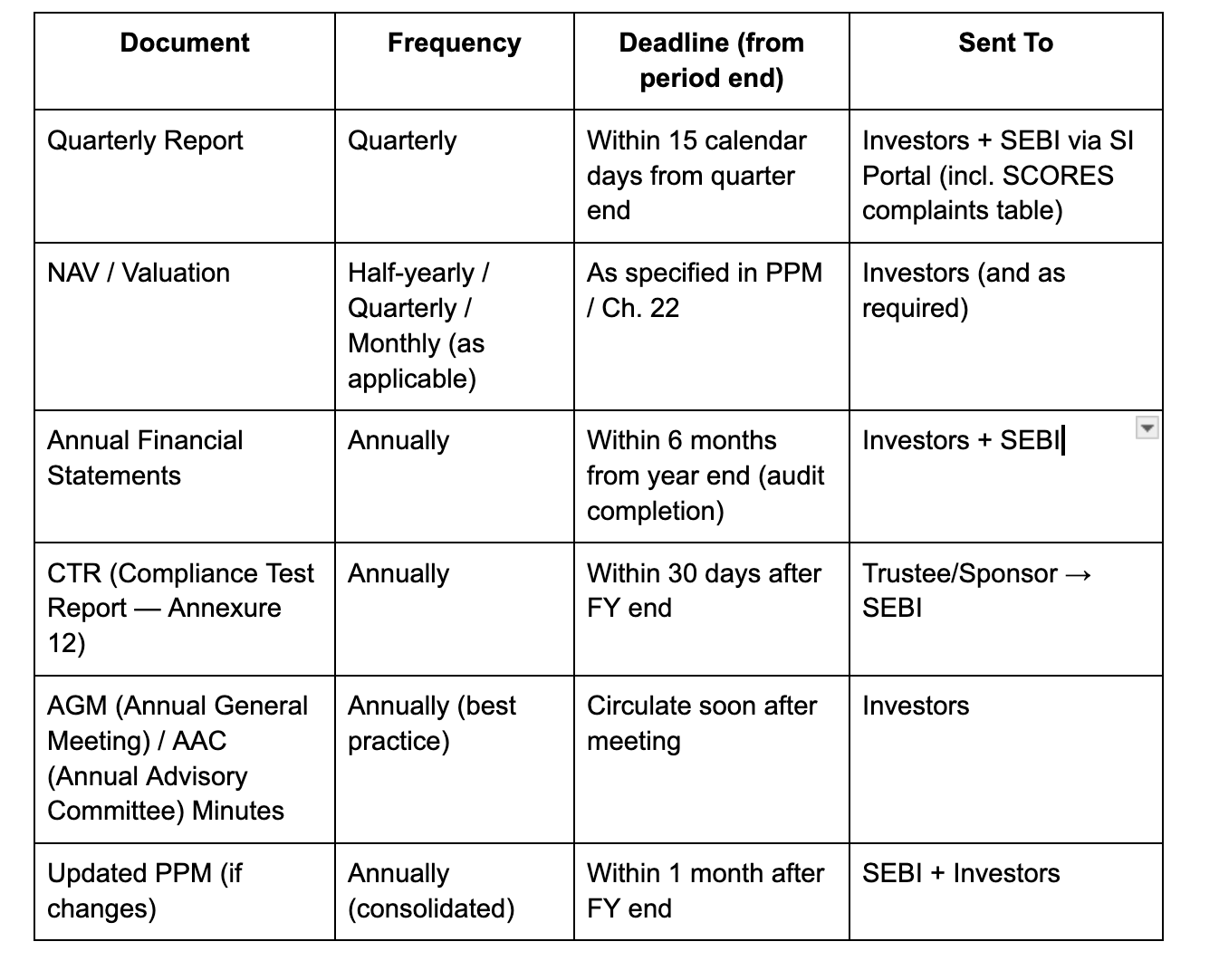
Submit findings to Trustee/Sponsor and to SEBI within 6 months from FY end
B) Quarterly Reporting
File standardized quarterly reports on SI Portal (SEBI Intermediary Portal) within 15 days of each quarter end
Include investor complaints data via SCORES (SEBI Complaints Redress System) if received, resolved or pending
C) CTR (Compliance Test Report)
Prepare CTR in Annexure 12 format
Submit to Trustee/Sponsor within 30 days of FY end
D) Units Dematerialisation (Investors’ Units)
Issue all units in demat form per corpus-based timelines
If investors lack demat details, use an Aggregate Escrow Demat Account
E) Investments Dematerialisation (AIF Portfolio Securities)
All investments made on or after July 1, 2025 must be held in dematerialised form
For certain earlier investments, demat by Oct 31, 2025 (limited exemptions, e.g., schemes ending by that date)
F) Valuation & Benchmarking
Appoint an Independent Valuer meeting SEBI eligibility; calculate NAV (Net Asset Value)
Provide required performance data to SEBI-registered benchmarking agencies under the AIF benchmarking framework
G) Material Changes
For any material change (e.g., fee changes, or change in sponsor/manager), follow the prescribed process, including exit options for dissenting investors where applicable
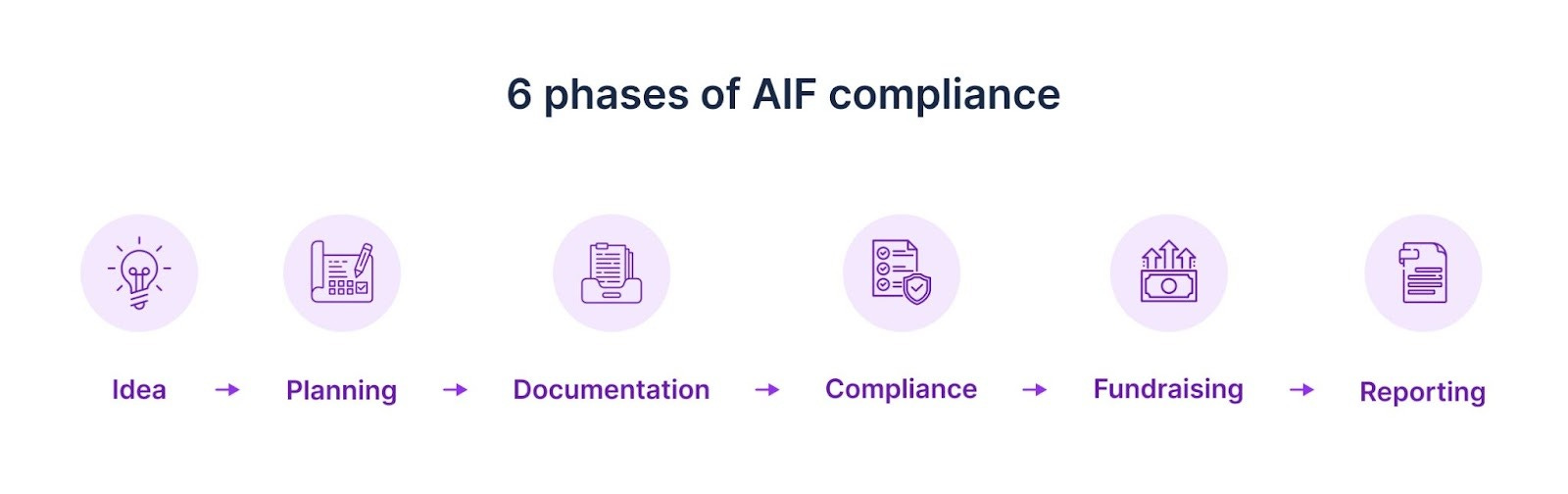
Quick Reference to Annual Compliance Cycle
Final Word
Regulations evolve. Bookmark SEBI’s site and watch for circulars. Build a reliable team and treat this checklist as your operating playbook.
Execute meticulously, stay transparent and focus on what matters most - delivering returns for your investors.