


SEBI Circular | November 5, 2026
The Securities and Exchange Board of India (SEBI), through its circular dated November 5, 2026, has revised the framework governing Accredited Investors (AIs), introducing measures intended to simplify and expedite the accreditation process across Alternative Investment Funds (AIFs), Specialized Investment Funds (SIFs) and Portfolio Management Services (PMS).
The circular follows amendments to the SEBI (Alternative Investment Funds) Regulations, 2012, notified on October 15, 2026.
One of the most significant changes is the introduction of an optional Manager-led accreditation mechanism, allowing eligible fund managers to determine and record an investor’s accredited status without requiring the investor to obtain a separate certificate from a recognised Accreditation Agency.
The circular also clarifies accreditation validity, qualifying securities market exposure, documentation requirements, accreditation of LLPs and the treatment of persons resident outside India.
1. Introduction of Manager-Led Accreditation
Previously, investors generally relied on recognised Accreditation Agencies to obtain an accreditation certificate.
Under the revised framework, an AIF Manager may independently determine and record an investor’s accredited status.
The Manager can undertake this determination:
At the time of investor onboarding.
During the tenure of an existing scheme.
The Manager must verify that the investor satisfies the eligibility criteria prescribed under the AIF Regulations and the circular.
Once accreditation is determined, the Manager must:
Record the investor’s accreditation status.
Confirm the accreditation in writing to the investor.
Communicate the date of accreditation and its validity period.
Importantly, this is an additional and optional mechanism. The existing Accreditation Agency route continues to remain available.
Where an investor provides a valid accreditation certificate issued by a recognised Accreditation Agency, the Manager must rely on that certificate and cannot undertake a fresh determination during its validity.
2. Recognition Across Managers Within the Same Group
A significant operational improvement is the recognition of Manager-led accreditation across Managers belonging to the same corporate Group.
Once a Manager determines an investor’s accredited status, the determination will be recognised by other Managers within the same Group for AIFs, SIFs and PMS during the validity period.
However, a Manager outside the same Group must independently determine the investor’s accredited status when onboarding that investor.
Investment Advisers and Research Analysts cannot independently determine accredited status. They may, however, rely on a valid determination made by a Manager within their Group.
3. Accreditation Validity: Three Years
The circular establishes a three-year validity period for both accreditation routes.
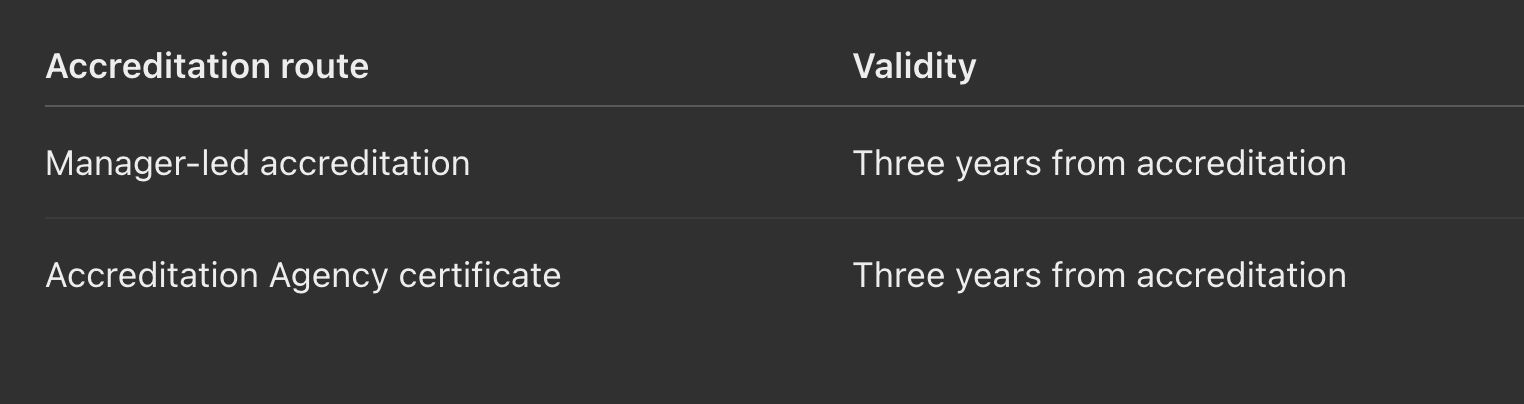
Additional clarifications:
Investors accredited at the time of onboarding into a scheme will continue to be treated as Accredited Investors for the remaining life of that scheme.
Existing certificates issued before the circular’s applicability will remain valid for their unexpired validity period.
Fresh accreditation is required when an investor is onboarded by a Manager outside the existing Manager’s Group.
4. Revised Securities Market Exposure Criteria
SEBI has specified the minimum qualifying securities market exposure as follows:
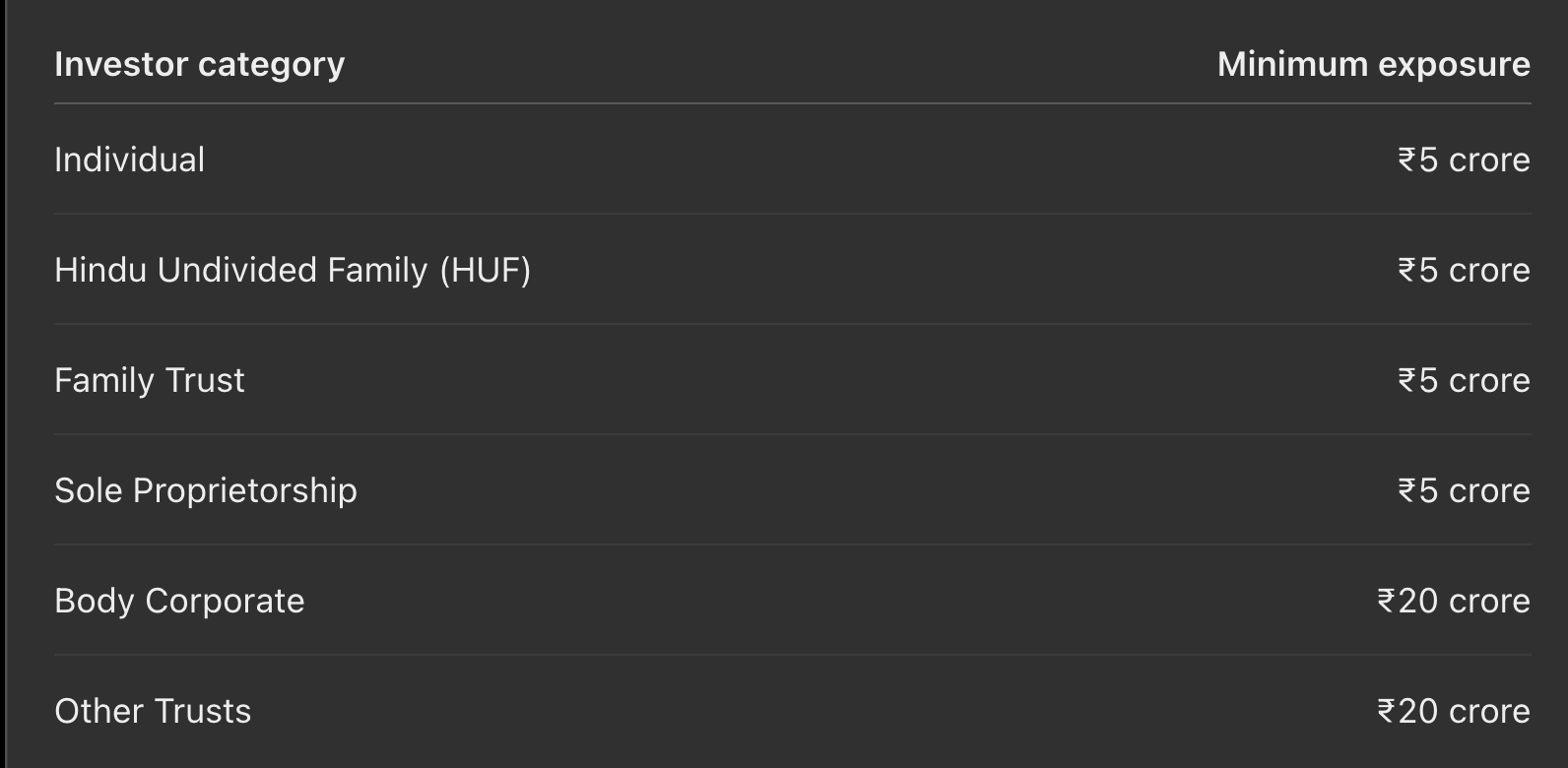
The circular also clarifies which investments can qualify as securities market exposure.
The following investments are eligible:
Securities held in dematerialised form.
Mutual fund investments held through mutual fund folios.
Unlisted securities held in dematerialised form.
Investments in overseas securities markets.
Investments under the National Pension System (NPS).
Valuation and supporting evidence
For securities held in dematerialised form, the value reflected in the eCAS statement as of the statement date will be considered.
For unlisted securities and overseas securities market investments that are not valued in the eCAS statement, investors must furnish a certificate from a practising Chartered Accountant identifying:
Nature of securities.
Valuation date.
Value of the securities.
5. Documentation Required for Accreditation
The circular specifies the documents that Managers and Accreditation Agencies must obtain to verify eligibility.
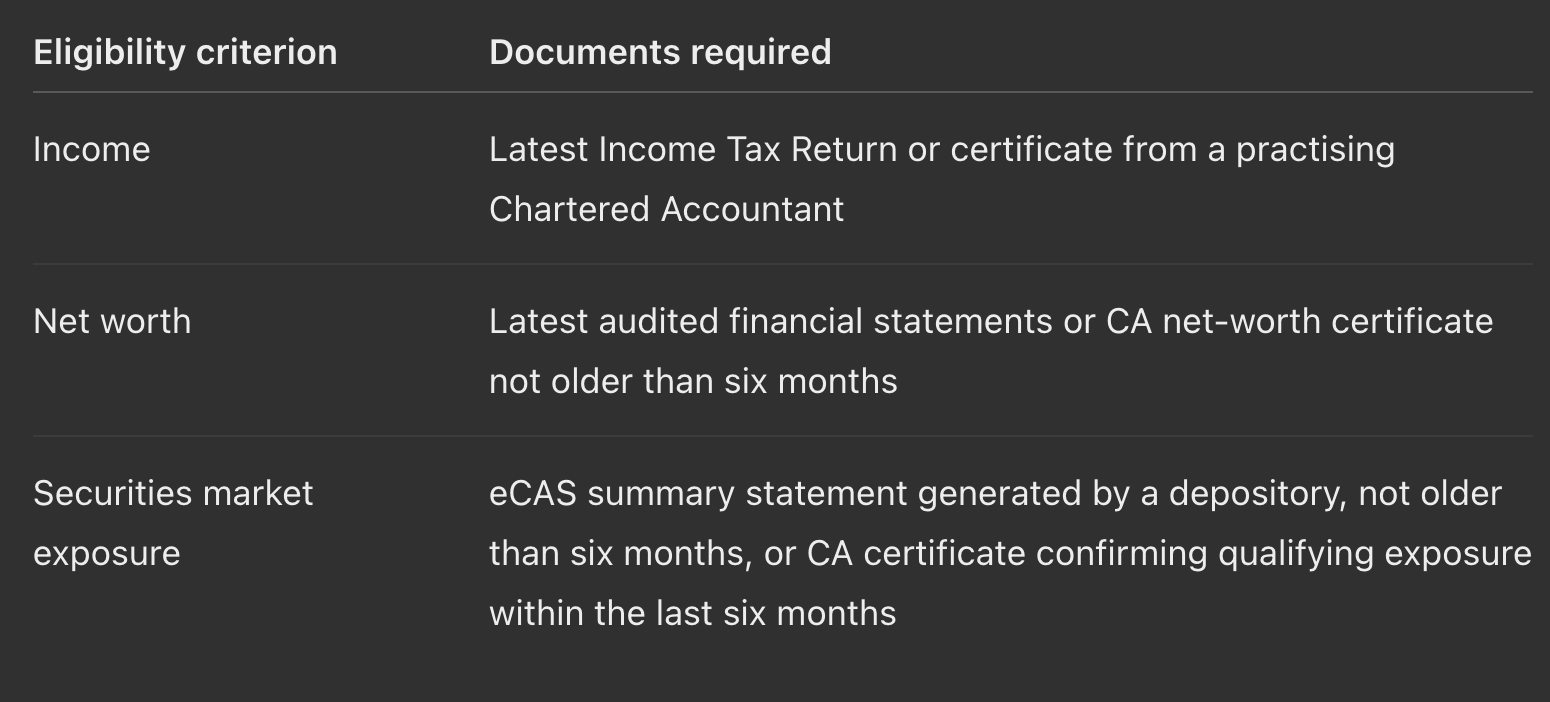
The Manager or Accreditation Agency must verify eligibility under Regulation 2(1)(ab) of the AIF Regulations.
6. New Accreditation Rules for LLPs
SEBI has specifically addressed the treatment of Limited Liability Partnerships (LLPs).
An LLP established under the Limited Liability Partnership Act, 2008, will qualify as an Accredited Investor if every partner independently satisfies the applicable accreditation eligibility criteria.
Where a partner is itself a body corporate, another LLP, a firm or a trust, that partner must independently satisfy the eligibility requirements applicable to its category.
This clarification is particularly relevant for investment structures and family investment vehicles organised through LLPs.
7. Persons Resident Outside India: Deemed Accredited Investor Status
One of the most important provisions for international investors is the treatment of Persons Resident Outside India (PROIs).
Under the revised framework, a Person Resident Outside India, as defined under FEMA, 1999, will be deemed to be an Accredited Investor.
Such investors:
Do not need to obtain an accreditation certificate from a recognised Accreditation Agency.
Do not need to undergo Manager-led accreditation.
Must still be identified and recorded by the Manager on the basis of their status as a Person Resident Outside India.
However, this deemed accreditation does not exempt AIFs and their Managers from their obligations under the Prevention of Money-laundering Act, 2002.
AIFs must continue to undertake client due diligence, identify beneficial owners and comply with applicable source-of-funds requirements.
8. Safeguards and Responsibilities for AIF Managers
While Manager-led accreditation reduces dependence on external agencies, SEBI has placed significant accountability on Managers.
Managers undertaking accreditation must implement the following safeguards:
A. Accountability
The Manager is responsible for ensuring compliance with the prescribed eligibility criteria and the requirements of the circular.
B. Record Maintenance
All supporting documents, records and verification evidence must be retained for at least five years from the date of accreditation or until five years after the investor ceases to be an investor in any scheme managed by the Manager, whichever is later.
These records must be made available for inspection when required.
C. Internal Audit
Periodic internal audit and compliance reviews of the accreditation process must form part of the Manager’s existing audit arrangements.
D. Accreditation Policy
Every Manager undertaking accreditation must adopt a formal accreditation policy covering:
Conflict-of-interest controls, including separation of accreditation from business development and distribution functions.
Escalation and grievance redressal mechanisms.
Record-retention infrastructure.
Data privacy and cybersecurity safeguards.
E. Documented Decision-Making
The Manager must document the accreditation decision, eligibility criterion relied upon and supporting verification evidence in a manner that enables independent review.
9. What Should AIF Managers Do Now?
The revised framework creates an opportunity for AIF Managers to streamline investor onboarding while taking on additional compliance responsibilities.
AIF Managers should consider the following action points:
Evaluate whether to adopt Manager-led accreditation or continue using recognised Accreditation Agencies.
Develop and approve a formal accreditation policy.
Establish internal procedures to verify income, net worth and securities market exposure.
Create standardised documentation checklists for different investor categories.
Implement a three-year accreditation validity and renewal tracking mechanism.
Maintain an auditable repository of investor documents and verification evidence.
Introduce appropriate segregation between accreditation, distribution and business development functions.
Update investor onboarding workflows to recognise deemed accreditation for Persons Resident Outside India.
Ensure that AML/KYC, beneficial ownership and source-of-funds checks continue independently of accreditation.
10. Effective Date
The circular comes into force with immediate effect from November 5, 2026.
SEBI has also updated the AIF Master Circular dated June 3, 2026, to incorporate the provisions of this circular.
Source: SEBI Circular HO/19/34/11(6)2026-AFD-POD1/I/25244/2026 dated November 5, 2026.
Conclusion
SEBI’s revised Accredited Investor framework is an important step towards simplifying investor onboarding in the Indian alternative investment industry.
The introduction of Manager-led accreditation, recognition across Managers within the same corporate Group, expanded securities market exposure categories and deemed accreditation for Persons Resident Outside India should reduce procedural friction for eligible investors.
However, the simplified process comes with greater responsibility for AIF Managers, particularly around eligibility verification, documentation, audit trails, conflict management and data protection.
AIF Managers should review their existing investor onboarding and compliance processes to incorporate the revised framework.