


Published: September 24, 2026
Category: AIF Compliance | SEBI Regulatory Updates
The Securities and Exchange Board of India (SEBI), at its 215th Board Meeting held on September 24, 2026, approved several regulatory reforms aimed at strengthening investor protection, simplifying compliance, and expanding participation in India’s alternative investment ecosystem.
Among the key decisions are amendments to the SEBI (Alternative Investment Funds) Regulations, 2012, and significant changes to the Accredited Investor framework.
These reforms could influence how AIF managers structure investor onboarding, manage regulatory compliance, and facilitate capital mobilisation.
1. Enhanced Investor Protection Extended to All AIF Structures
One of the most significant AIF-related decisions concerns the extension of investor protection provisions currently applicable to trust-structured AIFs.
What has changed?
Under the existing framework applicable to AIFs constituted as trusts, the Fund Manager or its officers cannot use the trust’s assets to pay for their own losses, damages, or expenses, including costs associated with resolving investor disputes.
SEBI has approved amendments to extend this protection to AIFs of all legal structures, irrespective of the form in which they are established.
Impact on AIFs and Fund Managers
The amendment reinforces the principle that fund assets must be protected from liabilities arising from the personal actions or obligations of fund managers and their officers.
Fund managers should review:
Fund constitutional documents and governing agreements.
Indemnity and expense-reimbursement provisions.
Policies governing the use of fund assets.
Internal controls for related expenses and investor disputes.
The objective is to ensure consistent investor protection across different AIF structures.
2. Accredited Investor Framework Expanded to Facilitate Capital Formation
SEBI has approved several changes to the Accredited Investor (AccI) framework to simplify accreditation and expand the pool of eligible sophisticated investors.
These changes are particularly relevant for AIF managers targeting high-net-worth individuals, family offices, institutional investors, and overseas investors.
Manager-Led Investor Accreditation
Under the approved framework, AIF Managers will be permitted to accredit investors as an additional and optional route.
The existing accreditation agency route will continue.
This means eligible AIF managers may be able to integrate investor accreditation into their onboarding workflows rather than requiring investors to complete a separate accreditation process through an external agency.
Potential Benefits for AIF Managers
Manager-led accreditation could:
Reduce duplication in investor verification.
Streamline investor onboarding.
Reduce time and administrative costs.
Improve the integration of accreditation with subscription and KYC workflows.
For fund managers operating multiple investment products, this could create opportunities for a more unified investor onboarding experience.
3. Securities Market Exposure Introduced as an Accreditation Criterion
SEBI has approved securities market exposure as an additional eligibility criterion for Accredited Investor status.
The approved thresholds are:
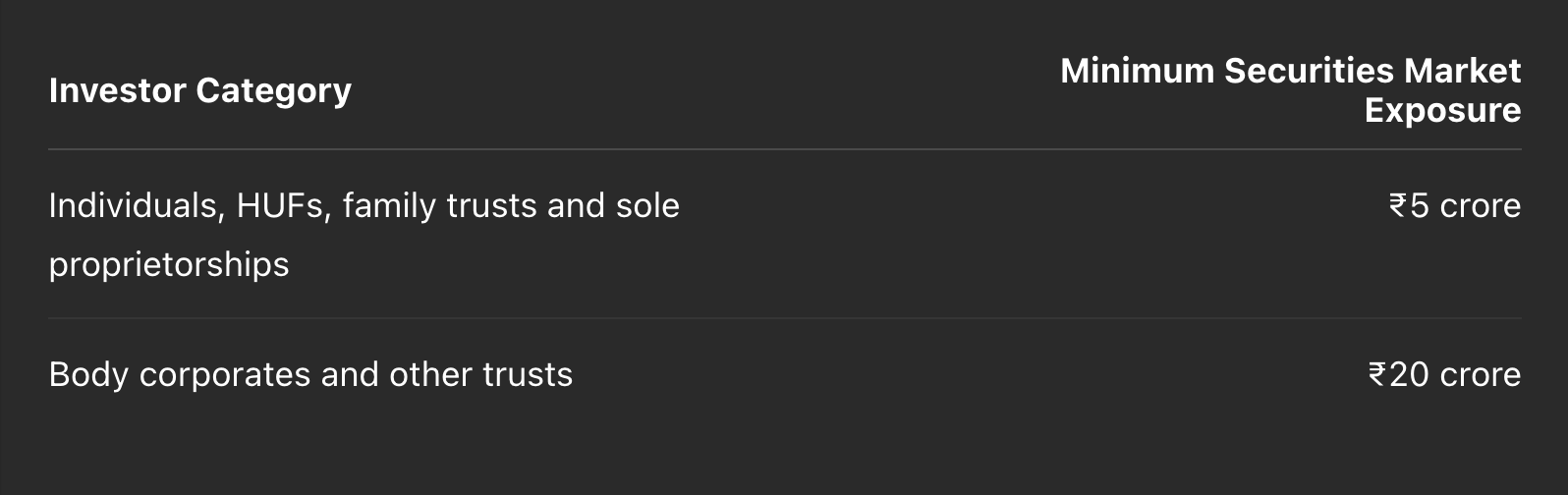
This provides an additional, digitally verifiable route for qualifying as an Accredited Investor.
Why This Matters for AIFs
The introduction of an investment-exposure criterion may broaden the pool of investors eligible to participate in products designed for sophisticated investors.
AIF managers may benefit from:
A larger potential accredited investor base.
More efficient verification using financial data.
Better targeting of sophisticated investors.
Reduced dependence on traditional income and net-worth-based assessment alone.
The change may also encourage technology-enabled verification systems that can validate securities market holdings and maintain supporting records.
4. Deemed Accreditation for Non-Residents
SEBI has also approved deemed Accredited Investor status for Persons Resident Outside India, as defined under FEMA, including Foreign Portfolio Investors.
Implications for AIF Fundraising
This measure is intended to ease access for sophisticated overseas investors to eligible Indian securities market products and facilitate foreign capital inflows.
For AIF managers, the development could support:
More efficient onboarding of eligible overseas investors.
Expansion of international fundraising initiatives.
Simplified accreditation-related processes for qualifying non-resident investors.
However, applicable FEMA, tax, AML/KYC, and other regulatory requirements will continue to require careful consideration.
5. LLPs Eligible for Accredited Investor Status
SEBI has approved eligibility for Limited Liability Partnerships (LLPs) to obtain Accredited Investor status where each partner is an Accredited Investor, in line with the existing framework for partnership firms.
This is relevant to investment structures involving family offices, investment partnerships, and professional investment vehicles.
AIF managers may need to consider how this eligibility change affects investor classification and onboarding documentation for LLP-based investors.
6. Three-Year Validity and Portability Within the Same Group
Under the approved framework:
Accreditation through either the manager-led or Accreditation Agency route will be valid for three years.
Manager-led accreditation will be portable across AIF, Specialized Investment Fund (SIF), and PMS products within the same group, subject to appropriate safeguards.
Operational Impact
This could reduce repetitive accreditation checks when an investor participates in multiple eligible products managed by the same financial group.
Fund managers operating multiple AIF schemes or diversified investment platforms may benefit from a more consistent investor verification framework.
Appropriate safeguards and implementation requirements will remain important.
7. What AIF Managers Should Prepare For
Although the Board has approved these proposals, the operational framework will depend on the subsequent regulatory amendments, notifications, and implementation directions.
AIF managers should begin evaluating the following areas:
Investor Onboarding Systems
Can your onboarding platform support:
Manager-led accreditation workflows.
Securities market exposure verification.
Accreditation validity tracking.
Documentation and audit trails.
Fund Documentation
Review whether investor agreements, subscription documents, and internal policies will need updates once the amendments are notified.
Conclusion
SEBI’s September 24, 2026 Board decisions signal continued efforts to modernise India’s alternative investment regulatory framework while strengthening investor protection and facilitating capital formation.
For AIF managers, the proposed Accredited Investor reforms could simplify onboarding, expand access to sophisticated investors, and reduce duplication across investment products.
At the same time, extending investor asset protection across all AIF legal structures reinforces the importance of robust governance and compliance controls.